Ask any solar project manager where a project went sideways and the answer is rarely the install itself. It’s the site survey that missed a subpanel, the financing milestone rejected over missing photos, the final inspection rebooked because nobody could find proof the racking was torqued.
In a 2025 survey of over 140 solar EPCs conducted with Solar Power World, 72% said they still don’t have specialized software for jobsite documentation, and 60% make at least one extra truck roll per project, at $400 or more each, just to collect missing photos.
Solar project management is the discipline of preventing those failures before they happen. This guide walks through best practices at every stage of the solar project lifecycle, from pre-sale survey to operations and maintenance, and shows where field operations software fits alongside the rest of your tech stack.
Key Takeaways
- Most solar project delays trace back to documentation gaps, not installation work. The fix is standardizing what gets captured at each lifecycle stage, not asking crews to “take more photos.”
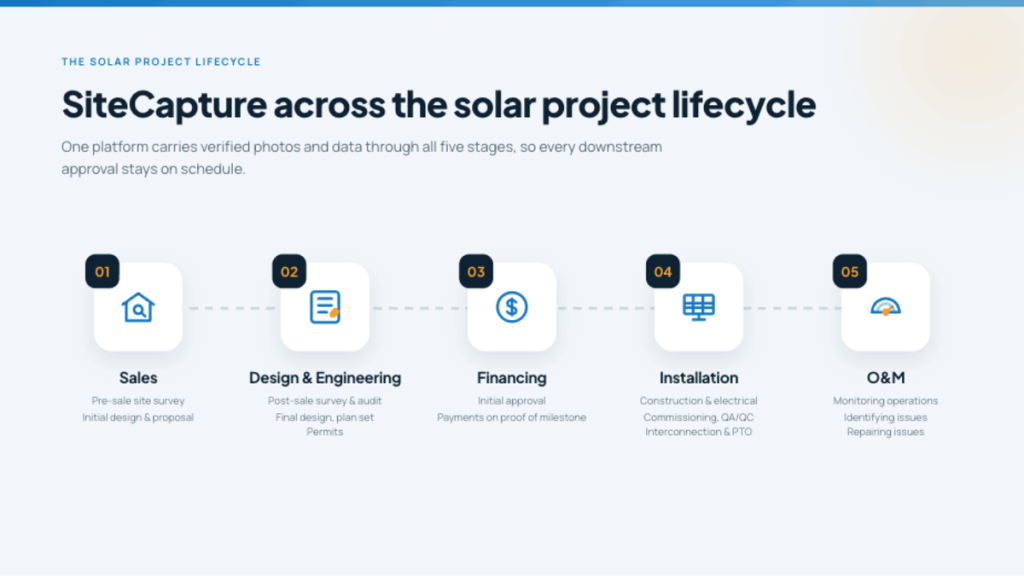
- The solar project lifecycle has five stages: sales, design and engineering, financing, installation, and O&M. Each has its own documentation requirements and failure points.
- Real-time field-to-office visibility is the single highest-leverage improvement. Decisions made on end-of-day reports are decisions made on stale data.
- Field operations software doesn’t replace your CRM, design tool, or financing platform. It feeds them the verified jobsite data they depend on.
- Contractors who standardize documentation see measurable results: EMPWR Solar raised first-time financing approval rates from 40% to 85% and cut funding cycles from 22 days to 9.
What Solar Project Management Involves
Solar project management means coordinating people, tasks, documentation, and approvals across a lifecycle that spans weeks to months and touches multiple stakeholders: the project manager, field crews, office staff, the customer, the utility, the AHJ (authority having jurisdiction), and increasingly a financing partner. As battery energy storage systems (BESS) become standard attachments on residential and commercial projects, the same discipline extends to storage: more equipment, more electrical scope, and more documentation per job.
It differs from generic project management in the constraints. AHJ permit timelines, utility interconnection approval timelines, weather exposure, and lender documentation requirements are all outside your control. What you can control is field discipline: whether every survey, install, and inspection produces complete, verifiable documentation the first time. Teams that get this right absorb external delays. Teams that don’t compound them.
The rest of this guide follows the solar project lifecycle stage by stage. A solar field operations platform like SiteCapture gives PMs and crews a shared, real-time view of project status across all five, which is the thread connecting everything below.
Managing the Five Stages of the Solar Project Lifecycle
1. Sales and the Pre-Sale Site Survey
Everything downstream depends on ground truth established here: roof condition and measurements, shading, main service panel capacity, structural load. Errors at this stage ripple through design, permitting, and installation, and often surface as change orders that erode both margin and customer trust.
Best practices:
- Run every solar site survey from a standardized checklist with required photo captures: roof sections, meter, main service panel, attic or structural access, site conditions. If a photo is required, the survey isn’t done without it. (For a full breakdown of what to capture and with what, see our guide to essential solar site survey tools.)
- Consider self-service surveys for pre-sale qualification. Homeowner-guided capture eliminates a truck roll per deal; A&R Solar cut 70 to 90 minutes of drive time per site visit and closed deals faster by moving surveys into the customer’s hands.
- Verify the survey against the proposal before it goes out. Inaccurate proposals don’t just lose deals, they create projects that were mispriced from day one.
With survey photos and form data captured in a mobile app and synced instantly to the office, sales can generate accurate proposals without waiting on manual uploads or callback questions to the field.
2. Design, Engineering, and Permitting
The post-sale survey or audit feeds final design and the plan set, which feeds the permit application. The most common failure here is a design built on incomplete site data, discovered either as a plan set rejection or, worse, by the install crew on the roof.
Best practices:
- Treat the post-sale audit as its own documented event, not a copy of the pre-sale survey. Confirm electrical details, measurements, and any site changes.
- Hold a design verification checkpoint before AHJ submission: does the plan set match the documented site conditions? Catching a discrepancy here costs an email; catching it after a permit denial costs weeks.
- Keep survey photos organized by project and phase so designers and permit techs can self-serve answers instead of re-rolling a truck.
- Where your AHJs support instant permitting platforms like SolarAPP+, complete and accurate site data is what makes automated submission actually work.
Consistent, complete site documentation directly reduces plan set rejections and accelerates design and permitting approvals.
3. Financing and Milestone Payments
Third-party ownership (TPO financing) now backs a majority of new U.S. residential solar, and it changes project management: financing partners like Palmetto LightReach, GoodLeap, and EverBright release funds on documented proof of milestones, typically an M1 package when installation is physically complete and an M2 package at system activation. Incomplete or non-compliant photo packages mean rejected submissions, and rejected submissions mean cash flow gaps that stall the whole pipeline.
Best practices:
- Build your financing partner’s documentation requirements into field workflows as required capture items, so the milestone package assembles itself as work happens rather than being reconstructed afterward.
- Review every M1 and M2 package for completeness before submission. First-time approval rate is the metric that matters; a single missing photo can delay funding by days or weeks. Smarter photo management is the fix.
- Track funding cycle time as a core project KPI, alongside install dates.
This is where standardized field documentation pays back hardest. EMPWR Solar moved first-time milestone approval rates from 40% to 85% and cut average funding cycles from 22 days to 9 by submitting standardized, audit-ready documentation directly from the field through SiteCapture’s Palmetto LightReach integration.
4. Installation, QA/QC, and Interconnection
Installation is the highest-risk phase for both schedule and quality, and the stage where field-to-office alignment matters most. The pattern behind most install delays: crews complete work, but the PM has no visibility until end of day, so problems are discovered late and decisions are made on stale information.
Best practices:
- Track defined milestones with sign-off gates: racking and mounting complete, modules installed, electrical and wire management complete, inverter installed and commissioned, inspections passed, interconnection application submitted. The exact sequence and inspection points vary by AHJ and system type (many jurisdictions require a rough inspection after mounting and conduit before work continues), so build your milestones around your local inspection regime, and don’t start a stage until the previous one is verified. Rework on mounted modules costs far more than a five-minute racking fix. (More in our solar panel installation best practices guide.)
- Give battery and storage installs their own documented scope. BESS adds equipment placement, serial number capture, wiring, and commissioning requirements beyond the PV system, and AHJs increasingly inspect storage separately. Our solar battery installation and maintenance best practices guide covers the full checklist.
- Document milestones with jobsite photo documentation, not checkbox ticks. Photo evidence is what AHJ inspectors, financing partners, and warranty claims all require.
- Log every issue with a photo, description, responsible party, and deadline. Verbal issue tracking fails on any project longer than a day.
- Run QA/QC at milestones, not just at closeout, and confirm the full photo set is complete before the crew leaves the site. A missing photo caught on-site is a two-minute fix; caught at inspection prep, it’s a $400+ truck roll.
- Keep a documented safety checklist per site. Solar installs involve roof work, fall protection, and live electrical; OSHA’s solar energy guidance applies regardless of crew size.
- Prepare interconnection and PTO (permission to operate) packages progressively so utility submission is an export, not a scramble. Most utilities grant PTO within weeks of a complete, accurate application; incomplete submissions restart the clock. A clean solar job closeout starts at kickoff, not at the end.
5. Operations and Maintenance
The project doesn’t end at PTO. Monitoring, inspections, and repairs run for decades, and O&M is where documentation habits either compound or collapse. Every photo and form captured during construction becomes the reference baseline for diagnosing performance issues later.
Best practices:
- Standardize solar O&M inspection and preventative maintenance forms so every tech captures the same data on every visit, across employees and subcontractors.
- Extend the same standards to storage. Battery maintenance has its own inspection cadence — state of charge, thermal conditions, firmware, enclosure integrity — and skipping it turns a revenue-generating asset into a warranty dispute.
- Tie work orders to documented proof of repair, closing the loop from issue identification to resolution.
- Centralize system data and field photos so performance analysis doesn’t depend on any one person’s memory or camera roll.
Omnidian standardized preventative maintenance workflows across 75+ partners and saved 400+ hours per month by automating maintenance documentation, completing 1,900+ projects in a single year on the back of it.
Where Field Ops Software Fits in Your Solar Tech Stack
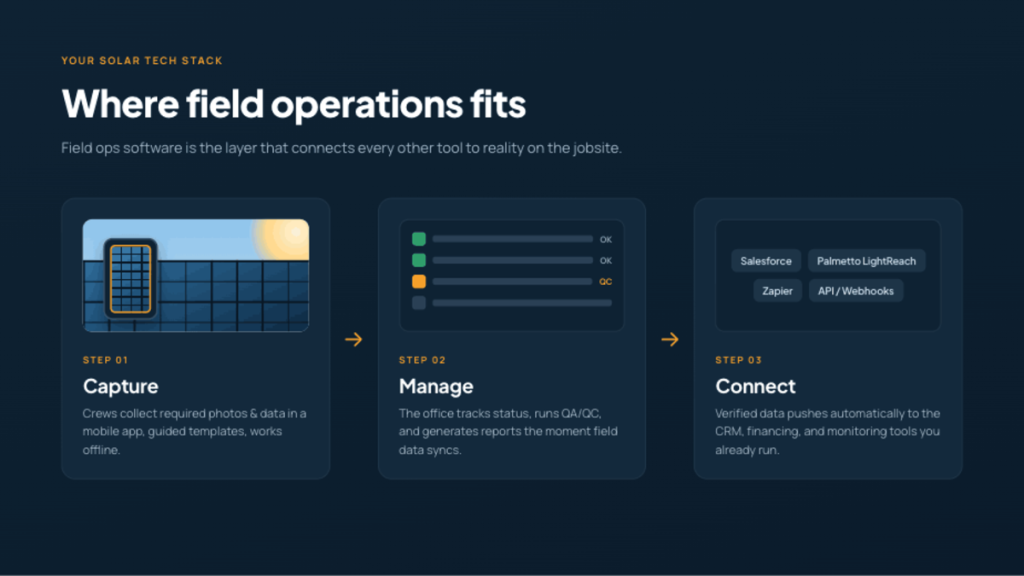
Solar project management isn’t done in one tool, and it shouldn’t be. A typical stack includes a solar CRM for pipeline, design and proposal software, a financing platform, an accounting system, and monitoring tools. What’s usually missing is the layer that connects all of them to reality on the jobsite.
That’s the role of field operations software. The workflow looks like this:
- Capture: crews collect required photos and form data through a mobile app, guided by templates that make required items impossible to skip, even offline.
- Manage: the office tracks status, runs QA/QC, and generates reports in a work management portal the moment field data syncs.
- Connect: verified jobsite data pushes automatically to the systems that need it, through native integrations with Salesforce, financing platforms like Palmetto LightReach, Zapier, and API/webhook access.
In practice: the site survey completed in the field updates the CRM record, gives the designer photo-verified site conditions, and pre-stages the financing milestone package, without anyone re-entering data. That’s why 85% of EPCs in the Solar Power World survey said field ops integration with other systems is important. Each tool in the stack gets better inputs: the CRM reflects true project status, proposals are built on verified site data, and financing partners receive complete packages the first time.
When evaluating solar project management tools, look for mobile-first capture with offline support, configurable templates per job type (PV, battery/BESS, EV charging), real-time sync, milestone and issue tracking, automated report generation, integrations with your existing stack, and AI-assisted quality control. Purpose-built beats generic here: the 72% of EPCs still running documentation through text threads and shared drives aren’t short on project management theory, they’re short on field data their office can trust.
How AI Is Changing Solar Project Management
The newest shift in solar project management is that quality control no longer has to wait for a human review. AI can now analyze field photos and data the moment they’re captured, which collapses the gap between “work done” and “work verified” — the gap where most rework, truck rolls, and funding delays live.
SiteCaptureAI applies this across the lifecycle:
- Photo and video intelligence verifies that required captures are present, correctly framed, and match what the project actually needs, from site surveys through closeout.
- Automated quality control reviews documentation against your standards and your financing partner’s requirements in minutes instead of hours.
- Real-time field alerts flag missing or failed items while the crew is still on-site, when the fix costs minutes instead of a truck roll.
- Custom AI workflows let teams automate the reviews specific to their operation: milestone submissions, inspection readiness, O&M reports.
The results compound quickly. Powur’s QA/QC and project funding teams save 12+ hours weekly and avoid 25+ truck rolls per month with 10x more photo documentation per project, because issues get caught before crews leave the jobsite rather than during office review days later. For a deeper look at where this is headed, see our guide to AI in field service management and how AI is transforming solar field operations specifically.
Run Tighter Solar Projects from Survey to PTO and Beyond
Effective solar project management comes down to consistent field discipline: documented, verified, and visible in real time at every stage of the lifecycle. Teams that build standardized documentation and quality control into each phase spend less time on rework, pass inspections and financing reviews the first time, and close projects clean instead of chasing paperwork after the crew has moved on.
SiteCapture is the #1 platform for solar field operations, used by 5,000+ companies across 10 million+ projects to streamline everything from site surveys to TPO financing to battery installs and O&M. See how it keeps field teams and project managers aligned from survey to closeout: schedule a demo.
FAQ
What does a solar project manager do?
A solar project manager coordinates every stage of a solar installation: site surveys, design verification, permitting, financing milestones, crew scheduling, quality control, utility interconnection, and closeout. The role centers on keeping field crews, office staff, the customer, the AHJ, and financing partners working from the same accurate, current project information.
What software do solar companies use to manage projects?
Most solar companies run a stack: a CRM (like Salesforce) for pipeline, design and proposal software, a financing platform, and field operations software like SiteCapture for jobsite documentation, QA/QC, and milestone tracking. Field ops software connects the stack to the jobsite by capturing verified photos and data in the field and pushing them to the other systems automatically.
What documentation is required for a solar installation?
Requirements vary by AHJ, utility, and financing partner, but a complete project record typically includes site survey photos and measurements, the permitted plan set, photo evidence at each installation milestone, commissioning and system completion reports, inspection sign-offs, interconnection and PTO documentation, and warranty paperwork. Projects with battery storage add BESS-specific requirements: equipment serial numbers, placement and clearance photos, and storage commissioning records. TPO-financed projects also require lender-specific M1 and M2 milestone photo packages.
How do you reduce delays in solar projects?
Standardize documentation at every lifecycle stage so nothing is missing when design, inspection, or financing needs it; verify photo sets before crews leave the site to avoid $400+ return truck rolls; track milestones with sign-off gates so problems surface early; and give the office real-time visibility into field progress instead of end-of-day reports.